
Ask anyone who has finished a full cycle of the 369 method what changed and they rarely lead with outcomes. They talk about a shift that is harder to photograph: somewhere in the third week, the sentence they had been writing stopped feeling like a request and started feeling like a description. This post is about that arc, week by week, so you know what to expect and when to trust the process over your feelings about it.
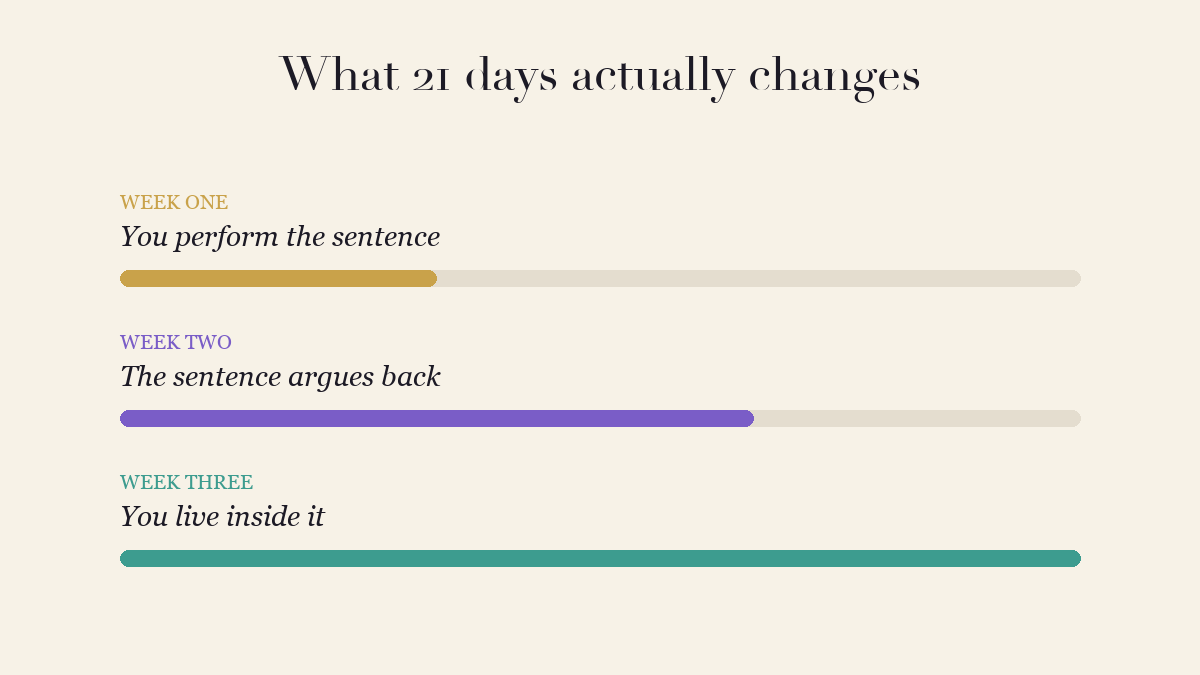
Week one: performing
The first days are easy because they are novel. You are trying on the sentence like a coat that does not fit yet. Expect self-consciousness: a voice that says this is silly, a flicker of embarrassment even though nobody is watching. This is normal and it is not a sign the practice is failing. It is the sound of an old self-image noticing a challenger.
Your only job in week one is mechanical: all three rituals, every day, felt or not. You are building the container.
Week two: friction
Week two is where cycles die. The novelty is gone, the outcomes have not arrived, and the writing starts to feel like homework. The afternoon session, the six lines of Frequency, is usually the first to slip, because midday is when the world is loudest.
Two things carry you through. The first is structure: fixed thresholds, reminders, a streak you do not want to break. The second is lowering the bar without lowering the standard: on the worst days, write mechanically and count it. A kept promise, even a flat one, tells your identity something a skipped day cannot.
This is also when the first coincidences tend to appear: an unprompted conversation, an idea in the shower, a door you had not noticed. Write them down. Individually they are nothing; recorded, they compound into a case. This is what the Evidence Journal in 369 Rituals is for.
Week three: inhabiting
Somewhere around day fifteen to eighteen, most people report the same quiet shift: the sentence writes differently. Less like asking, more like remembering. You catch yourself making a small decision, what to say yes to, what to let pass, the way the person in your sentence would make it. That is the real product of the cycle. Outcomes follow behaviour, and behaviour follows identity.
By the final days, the evening nine lines feel less like practice and more like signing your name.
After the cycle: rest, then choose
Finish properly. Mark the last day, reread your evidence journal, and take a few days off before you choose what is next. The pause matters: it lets the cycle settle and keeps the practice from becoming wallpaper.
Then either go again with the same intention, deeper, or choose the next one. For intentions that need more room, identity work rather than a single goal, the longer 28 and 33 day journeys exist for a reason: 33 days is the trinity’s own number, three elevens, and it gives the shift of week three another ten days to harden into habit.
Choosing your first cycle
- 3 or 7 days: a taste. Good for testing an intention’s phrasing before committing.
- 14 days: enough to feel the week two wall and get through it.
- 21 days: the classic. Long enough for the wanting-to-being shift in most people.
- 28 or 33 days: the deep end, for intentions about who you are rather than what you get.
If you have not started yet, the mechanics are in the complete guide, and the morning practice that anchors it all is in Morning Energy. Twenty-one days from now you could be reading your own evidence instead of ours.
What to watch for, week by week
| Week | What it feels like | The trap |
|---|---|---|
| One | Novel, slightly theatrical. The sentence sounds like costume. | Deciding it is not working because it feels performed |
| Two | Friction. The sentence argues back and the writing feels like effort. | Quitting. Almost everyone who abandons a cycle does it here |
| Three | It reads as description rather than claim. Often duller, which is the point. | Mistaking the quiet for nothing happening |
Week two deserves the warning it gets. The friction is not evidence the
sentence is wrong, it is what it feels like when a claim meets a self-image that
does not yet hold it. That collision is the mechanism, not a fault in it.
How to choose your first intention
Three tests, in order of usefulness.
Is it about you? Intentions inside your own authority behave
far better than ones that depend on another person’s decisions or on a specific
external event landing by a specific date.
Can you feel it without bracing? Read it aloud. If your body
tightens, the pitch is too high. Step it down until it lands as plausible.
Would you still want it in three weeks? A cycle is long
enough that a passing want will not survive it. Pick the one that would still
matter in a month.
If nothing obvious presents itself, self-worth is almost always a good first
cycle, for the reasons in
the 369 method for confidence.
Quick answers
Why 21 days for the 369 method? It is long enough to move past novelty and short enough to finish, which is the whole reason it became the common starting cycle. There is nothing magic in the number. Habit research from UCL puts the median time for a behaviour to feel automatic nearer 66 days, so treat 21 as the arc that starts the change rather than the one that completes it.
What happens in each week of a 369 cycle? Week one you perform the sentence and it feels like costume. Week two it argues back, which is the week most people quit in. Week three it starts reading as description rather than claim. The friction in week two is the practice working, not failing.
Should I do 21, 28 or 33 days? Start at 21. Move to 28 or 33 for a second cycle, or when the intention is identity-shaped and you want the habit properly settled. Finishing a shorter cycle beats abandoning a longer one.
Can I take a break between cycles? Yes, and it is worth doing. A few days of rest before choosing the next intention stops the practice becoming machinery, and gives you a chance to notice what actually changed.
What do I do after the 21 days are over? Rest, then choose deliberately: carry the same intention deeper, or pick the next one. Do not roll straight into a new sentence on day 22 out of momentum.
Does the streak have to be unbroken? No. A missed day resets a counter, not the rehearsal. Write again the next morning. Restarting from day one after every slip is the fastest way to quit.
Sources and further reading
- How long does it take to form a habit? (University College London): the research behind the 66-day average, and why cycles beat bursts
- The power of visualization (Psychology Today): what mental rehearsal does, from sports science to daily life