The 369 manifestation method is a writing practice. You choose one intention, phrase it as a single sentence, and write it three times in the morning, six times in the afternoon and nine times in the evening. You repeat that daily for a set cycle, often 21 or 33 days. That is the whole method. The depth is in the doing.
This guide covers where the method comes from, exactly how to practise it, real examples you can adapt, why so many people find it works on them, and the mistakes that quietly break it.
What the 369 method actually is
Strip away the mystique and you find a deceptively simple structure: one intention, repeated in writing, at the three natural thresholds of the day.
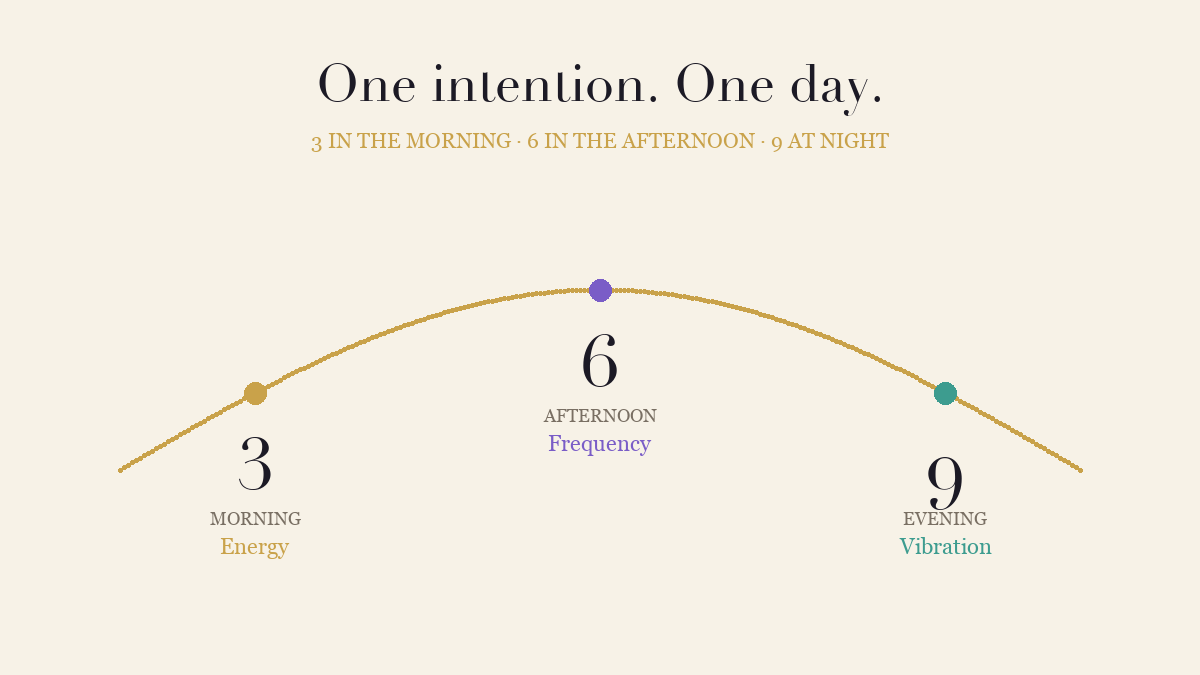
- Morning, 3 times. You write before the day has made its claims on you. The intention gets the first word.
- Afternoon, 6 times. You return at the day’s peak, when it would be easiest to forget, and double the dose.
- Evening, 9 times. You close the day inside the intention, so it is among the last things your mind holds before sleep.
The rhythm matters more than the arithmetic. Three writing sessions a day means your intention interrupts your ordinary thinking three times, every day, for weeks. Nothing you merely think about gets that kind of airtime.
Where it comes from
The numbers trace back to Nikola Tesla, who was famously obsessed with 3, 6 and 9. He is widely quoted as saying that anyone who knew “the magnificence of 3, 6 and 9” would hold “a key to the universe”. Whether Tesla said those exact words is debated by historians, and we think honesty makes the practice stronger, not weaker: the quote is part of the method’s mythology. What is documented is Tesla’s lifelong ritualistic attachment to the number three.
The writing method itself is modern. It grew out of scripting practices in the manifestation community and spread widely around 2020, when creators online combined Tesla’s numbers with the older habit of writing affirmations daily. If you want the deeper story of the numbers, we wrote about it separately in Why 3, 6 and 9?
How to do the 369 method, step by step
1. Choose one intention
One. Not five. The method concentrates attention, and attention divided is attention lost. Pick the thing that matters most this season of your life.
2. Phrase it as if it is already true
Write in the present tense, first person, positive form. “I am attracting abundance into every area of my life” rather than “I want to stop being broke”. Your sentence should be short enough to write nine times in the evening without resenting it, and vivid enough that writing it makes you feel something.
Three quick rules keep the phrasing honest. Use “I am”, never “I want” or “I will”, because both of those quietly affirm that you do not have it yet. State what you do want, not what you are leaving behind. And keep it specific enough to picture, but not so long it becomes a chore.
3. Write it 3, 6 and 9 times through the day
Morning before the noise, afternoon at the peak, evening before sleep. Write by hand or type, but write, do not recite. The physical act is the point: it is slower than thought, and that slowness is where the intention sinks in.
4. Feel it, then release it
The repetitions are not a chore to complete but a state to enter. Write, feel the sentence as true for a moment, and then let it go. Grasping at an intention all day keeps you in the state of lacking it. Write it, release it, live your day.
5. Repeat for a full cycle
Common cycles are 3, 7, 14, 21, 28 or 33 days. Three weeks is the classic. The early days feel like performing; somewhere in the middle the sentence stops being something you say and starts being somewhere you live. We wrote about that arc in From Wanting to Being.
369 method examples
The hardest part for most people is not the routine, it is the sentence. Here are examples in the correct form, present tense and positive, that you can adapt. Change the words until they sound like you. The feeling behind the line matters more than the exact wording.
- Money and abundance: “I am financially free, and money flows to me easily and often.”
- Love: “I am in a loving, honest relationship with someone who truly sees me.”
- Confidence: “I am calm, grounded and sure of myself in any room I walk into.”
- Career: “I am doing work I love, and I am paid generously for it.”
- Health and calm: “I am at peace, and my body feels well, rested and strong.”
- A specific goal: “I am so grateful now that I have passed my exam with ease.”
Notice what they share. Each one assumes the end as already true. Each is short enough to write nine times at night without resenting it. And not one of them is a plea. If your sentence begins with “I want”, “I need” or “please”, rewrite it until it begins from having, not wanting.
Why it works on you
You do not need to accept any metaphysics to see the mechanism. A few honest observations:
Attention is selective. Your brain filters almost everything it perceives. What you rehearse daily gets flagged as relevant, and things flagged as relevant get noticed: the opening, the person, the idea that was always there. Repetition retunes the filter.
Identity follows evidence. Writing “I am” sentences daily is a quiet argument with your old self-image. At first the new sentence loses. Around week two it starts winning, and people who believe a thing about themselves act differently, usually in ways that make the thing more likely.
Structure beats motivation. Three fixed appointments a day will carry you through the days when you feel nothing. Any practice that survives your bad days changes you.
We make no promises about outcomes, and you should be wary of anyone who does. The practice is the point. What you can fairly expect is a mind that returns, many times a day, to what you are building.
The part most people skip: feeling it
Here is the quiet truth about the 369 method. The writing is not the magic. The writing is what carries the feeling, and the feeling is what does the work. Nine lines written while you rehearse your overdraft do almost nothing. The same nine lines written while you feel, for a few seconds, the settled relief of already having what you want, are a different practice entirely.
This is exactly what teachers like Neville Goddard meant by “feeling is the secret”. If you want the 369 method to move from a writing drill to a genuine practice, it is worth borrowing his approach to the feeling, which we cover in the 369 method, the Neville Goddard way, and in the wider guide to his techniques. Tesla’s numbers give you the structure. Neville gives you the state to bring to it.
The mistakes that break it
- Changing the intention mid-cycle. Restlessness resets the clock. Choose carefully, then hold.
- Writing on autopilot. Nine mechanical lines do less than three felt ones. Slow down. Arrive first: a few deep breaths before writing changes everything.
- Treating a missed session as failure. Life happens. Finish the day’s writing before midnight and the day still counts. A missed day is information, not a verdict.
- Keeping no record. Coincidences compound quietly. If you do not write down the small signs and shifts as they appear, you will forget the practice is doing anything at all.
Pen and paper, or an app?
A notebook works, and has worked for decades. What a notebook will not do is open your writing with a breath ceremony, count your lines while you stay in the feeling, remind you at the day’s three thresholds, track your streaks and moon phases, or hold an evidence journal alongside your intention.
We built 369 Rituals to be the most beautiful way to keep this practice: three guided daily rituals, cycles from 3 to 33 days, meditation and visualisation built around the same trinity, and complete privacy. Nothing you write ever leaves your phone. No account, no tracking, no data collected.
Related practices worth knowing
If you are weighing this against everything else on offer, the complete guide to manifestation techniques lays all of them side by side with what each is actually for.
Two techniques sit either side of the daily writing and make it work better. Scripting comes first: a longer passage written once, in the present tense, to find out what you actually want before you commit a cycle to it. Living in the end comes after: a short scene, felt from the inside, that gives the sentence somewhere to land. Neither replaces the eighteen daily writings, and both are covered honestly, including where the research says imagining can work against you.
And if you are deciding between pen and paper and something on your phone, how to choose a manifestation app lays out the trade-offs, ours included.
Quick answers
Does the 369 method really work? It works the way any focused practice works: by retuning your attention and slowly shifting how you see yourself, which changes how you act. Treat it as a discipline for focus and identity rather than a wish granted by numbers, and you will not be disappointed. Anyone promising guaranteed results is selling something.
How long until I notice anything? Most people report the practice feeling different, more inhabited and less performed, somewhere in the second week.
369 method or the 555 method? The 555 method is writing one affirmation 55 times a day for 5 days. The 369 method spreads fewer repetitions across the three thresholds of the day, for a longer cycle. The 369 is gentler and better suited to a lasting habit; 555 is a short, intense sprint.
Can I type it, or does it have to be handwritten? Either works. Handwriting is slower, and that slowness helps the words land, but a phone you always carry beats a notebook you leave at home. Consistency matters more than the tool.
What if I feel nothing when I write? Common, and not a failure. Slow down, take a breath before you start, and read the line as if it were already true rather than reciting it. The feeling usually arrives with the habit.
Can I have two intentions? Run them in sequence, not in parallel. One cycle, one intention.
What if I miss the morning? Write when you remember. A day finished late beats a day abandoned.
Keep reading
Three natural next questions, each answered honestly on this Journal: does the 369 method actually work?, what are the real rules (and which “rules” are myths)?, and how does 369 compare with the 555 method?
Sources and further reading
- How long does it take to form a habit? (University College London): the research behind the 66-day average, and why cycles beat bursts
- Breath control helps quell the stress response (Harvard Health): the physiology behind the long exhale in the 6·3·9 breath
- Nikola Tesla (Britannica): the life behind the legend of the numbers