The 369 method tells you exactly what to do. Choose one intention, write it three times in the morning, six in the afternoon, nine at night, and repeat for a cycle. It is a beautifully simple structure. But on its own it is only a structure, and plenty of people run it for weeks like a spelling drill and feel nothing move.
What the method rarely comes with is the part that makes it work: the feeling. And no one taught that better than Neville Goddard.
This is where the two fit together. The 369 method gives you the discipline and the rhythm. Neville gives you the inner state that the writing is supposed to carry. Put them together and the practice stops being a numbers game and becomes what it was always meant to be.
Who was Neville Goddard?
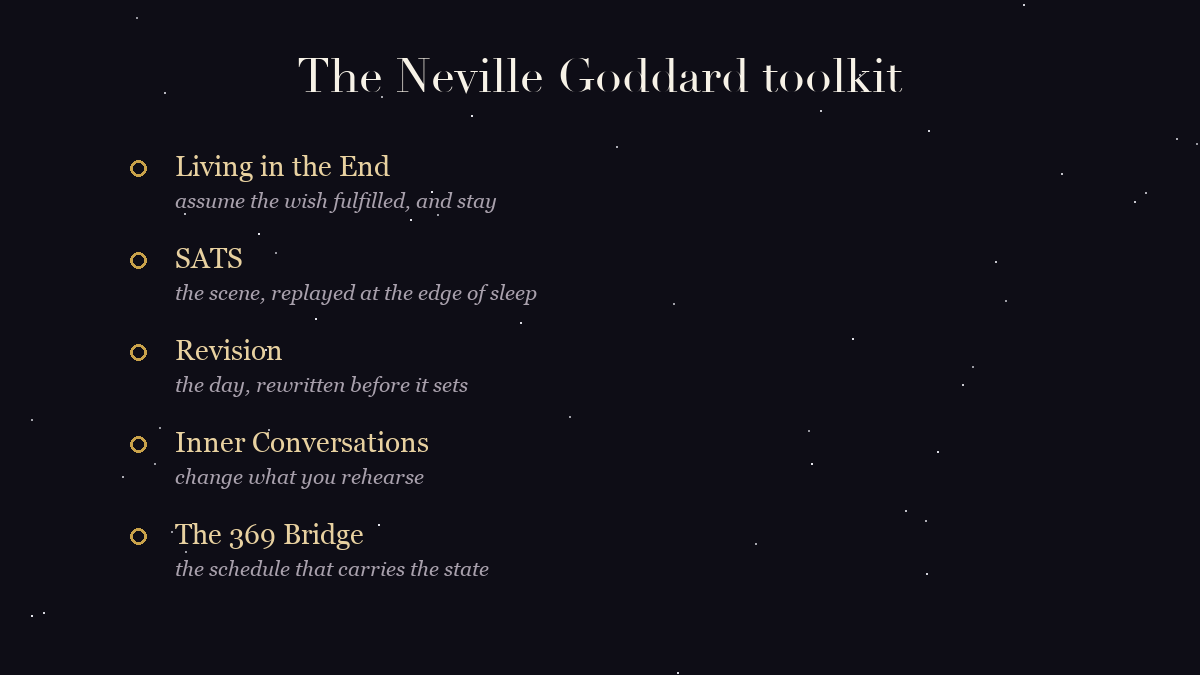
Neville Goddard was a 20th-century teacher of what he called the law of assumption: the idea that your assumptions about yourself, held and felt as true, shape what you experience. His teaching sits underneath most modern manifestation advice, usually uncredited. If you have ever heard the phrases “living in the end,” “feeling is the secret,” or “assume the wish fulfilled,” you have heard Neville.
His whole philosophy reduces to one uncomfortable, freeing sentence: you do not attract what you want, you become the person who already has it, and you do it in your imagination first.
Why the 369 method needs it
Here is the failure most people hit. They write “I am financially free” nine times while mentally rehearsing their overdraft. They copy the words and completely skip the state. The pen moves and nothing else does.
Neville would say the words were never the point. Repetition on its own is just penmanship. What impresses on you, in his language, is the feeling of the assumption being true. The 369 method, done his way, uses the writing as a doorway into that feeling rather than as a substitute for it.
The secret is feeling. If you want to change your life, you must start by changing the feeling of your life. Neville Goddard’s teaching, in one line.
So the writing is not the work. The writing is what walks you to the work.
Write it, feel it, release it
There is a clean way to hold the two practices together, and it happens to be three steps for a method built on threes. Each one maps to something Neville taught.
Write it: the discipline (this is the 369 part)
This is the mechanical layer, and it matters. Choose one intention. Phrase it in the present tense, as a fact rather than a request: “I am,” not “I want” or “I will.” Then write it three times in the morning, six in the afternoon, nine in the evening, and keep the same words for the whole cycle. If you are new to the structure, our complete guide to the 369 method walks through it step by step.
The reason the day is split into three is not superstition. Morning writing sets the assumption before the world has made its claims on you. Afternoon returns to it at the point you would otherwise forget. Evening plants it last thing, closest to sleep, which is exactly where Neville wanted it.
Feel it: the assumption (this is the Neville part)
This is the step almost everyone drops, and it is the one that does the work. After you write the line, do not rush to the next repetition. Pause and let the sentence be true for a moment. Not “wouldn’t it be nice,” but the quiet, settled feeling of it already being the case.
Neville called this “feeling is the secret.” The imagination has to supply the emotion that a real event would supply. If the intention is a calmer life, feel the calm now. If it is work you love, feel the ordinary Tuesday of already having it. The 369 structure gives you fifteen or eighteen small windows a day to practise exactly this, which is far more than most people ever give it.
His companion technique, which he called SATS (a state akin to sleep), is worth borrowing here. In the drowsy minutes before you fall asleep, replay a short scene that implies your intention has already happened. A phone call, a handshake, a glance in the mirror. The evening nine, done just before bed, sets this up perfectly.
Release it: living in the end (the part that frees you)
The final step is the one that feels backwards. Having written it and felt it, you let it go. You do not check the post for evidence. You do not refresh your bank balance. You do not spend the afternoon wondering whether it is “working.”
Neville called the destination “living in the end”: you assume the wish is already fulfilled and then, crucially, you go about your day from that assumption rather than reaching for it. Reaching is a signal that you do not yet have it. Neediness affirms lack. Release affirms that the matter is settled.
This is also, quietly, the healthiest part of the whole practice. It asks you to want something sincerely and then stop clutching it. That is a good way to hold most things in life, not only intentions.
A worked example
Say your intention is confidence. Here is the same line, run the shallow way and the Neville way.
Shallow: you write “I am calm and confident” nine times while feeling anxious and slightly silly, ticking off repetitions.
Neville’s way: you write “I am calm and confident,” then pause and recall, or imagine, the physical feeling of walking into a room already at ease. Shoulders down, breath slow. You write it again from inside that feeling. In the evening, half asleep, you replay a ten-second scene of handling a moment that usually rattles you, and handling it easily. Then you close your eyes and let it be done.
Same words. Completely different practice. Only one of them changes anything.
The mistakes that undo it
- Writing without feeling. The single most common one. If you are only moving a pen, you are doing calligraphy, not manifestation.
- Changing the intention every few days. Both practices depend on a settled, repeated assumption. Chopping and changing tells your own mind you do not believe any of them.
- Checking for proof. Monitoring the outcome is the opposite of living in the end. It reintroduces the lack you were trying to leave behind.
- Phrasing it as a request. “Please let me” and “I want” both affirm not-having. Neville was firm on this: assume the end, do not beg for it.
Two neighbouring pages are worth reading next. The law of assumption sets out the idea underneath everything Neville taught, and SATS covers the bedtime technique that pairs most naturally with the evening nine writings.
Quick answers
Do I have to believe in Neville Goddard for the 369 method to work?
No. You can treat “feeling it real” as pure psychology if you prefer: rehearsing a state makes it more familiar and more available. The instruction is the same either way. Feel the intention as true while you write it.
Is the 369 method actually from Neville Goddard?
No. The 369 method draws its numbers from Nikola Tesla’s fascination with 3, 6 and 9, and we cover that story in why 3, 6 and 9. Neville is a separate teacher. Combining them is a modern move, and a good one, because Tesla’s numbers give you the structure and Neville gives you the state.
When is the best time to do the feeling work?
The evening repetitions, done just before sleep, are the most powerful, because a drowsy mind accepts an assumption with far less argument. That is the whole basis of Neville’s SATS technique.
Bringing it together
The 369 method is the body of the practice and Neville Goddard is the breath in it. Write it, so the intention has a shape and a rhythm. Feel it, so the words carry a state and not just ink. Release it, so you live from the end instead of chasing it.
That is the practice 369 Rituals was built to hold. The three daily writing rituals, a breath ceremony to help you drop into the feeling before you write, and a moment of release when the day’s rituals are done. Write it. Feel it. Release it.
Sources and further reading
- Neville Goddard (Wikipedia): the teacher behind living in the end, SATS and revision
- Hypnagogia (Sleep Foundation): the drowsy threshold where bedtime practices land deepest