The law of assumption is the idea at the centre of Neville Goddard’s teaching, and it can be said in one sentence: you experience what you assume to be true. Not what you wish were true, not what you affirm on good days, but what you quietly, habitually take for granted about yourself and your world. Change the assumption, Neville taught, and the experience must follow. This guide explains the idea simply, separates it from the law of attraction it is often confused with, and shows how to actually practise it.
Where the idea comes from
Neville Goddard was a Barbados-born teacher who lectured in America from the 1930s to his death in 1972. His claim was radical in its economy: imagination creates reality, and an assumption, an imagined state accepted as fact, hardens into experience whether the assumption is wanted or not. “Assume the feeling of the wish fulfilled” was his constant instruction, and every technique he taught is a way of doing exactly that. His wider toolkit is covered in our complete guide to Neville Goddard’s techniques.
What an assumption actually is
An assumption is not a thought you have; it is the ground you think from. You do not affirm that the floor will hold you, you walk on it. You do not hope your name is your name, you answer to it. Neville’s observation was that your self-image works the same way: “I am bad with money”, “people like me”, “things never work out for me” are not conclusions you reach each morning, they are floors you walk on without looking down. And because you never question them, they quietly select what you notice, what you attempt, what you tolerate and what you expect, which is how they come to look like fate.
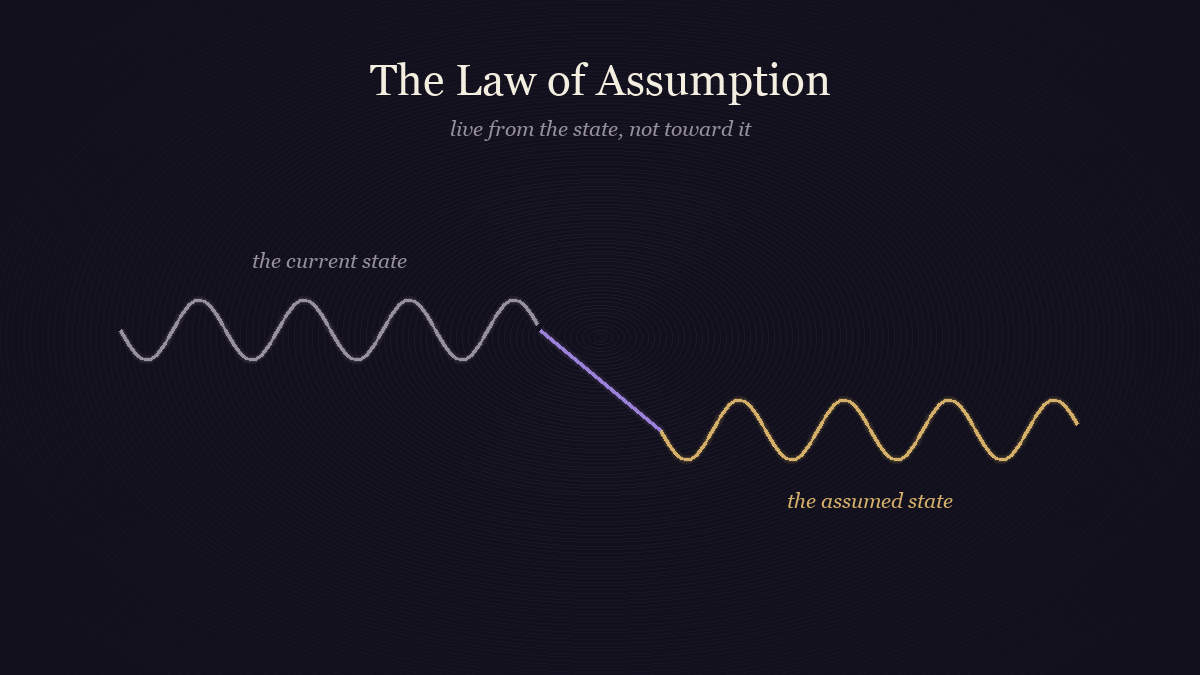
The law of assumption is simply this mechanism named and pointed deliberately: if unexamined assumptions have been shaping your life all along, then a chosen assumption, held with the same casual certainty, will shape it too.
Assumption vs attraction: the difference that matters
The law of attraction, as popularly taught, says like attracts like: hold positive thoughts and positive things are drawn to you from outside. The law of assumption makes a stronger and stranger claim: there is no outside doing the delivering. Consciousness is the only reality, your assumption is the cause, and the world is more mirror than marketplace. You do not attract what you want; you express what you are, and you can choose what you are.
Practically, the difference shows up in where you put the effort. Attraction work tends to focus on managing thoughts, keeping the vibration high, watching for signs. Assumption work focuses on one thing only: the state you are living from. Not “am I thinking positively about the promotion” but “am I being the person who already has it”. The first is exhausting. The second, once it clicks, is almost restful.
How to practise the law of assumption
1. Decide the state, not just the thing
Name the desire, then translate it into identity. Not “I want ten thousand pounds” but “I am financially at ease.” The thing is a snapshot; the state is the person the snapshot belongs to.
2. Assume it now, in small ways
Neville’s test was always feeling: what would be different in your body, your pace, your decisions, if it were already true? Answer with behaviour. The financially-at-ease version of you does not refresh their banking app with dread. The loved version of you does not audition. Borrow those behaviours now; they are the assumption made flesh.
3. Persist through the argument
The old assumption will produce evidence for itself for a while, because the world is still developing yesterday’s film, as Neville put it. Persistence, returning calmly to the new state every time you notice the old one, is the entire discipline. This is what his phrase living in the end means: you do not visit the fulfilled state, you move in.
4. Give it a daily container
An assumption with no ritual dissolves by Thursday. This is precisely where a written practice earns its keep: the 369 method done the Neville way gives the new assumption three appointments a day, morning, afternoon and evening, where it is written, felt and released in the present tense. Eighteen felt repetitions a day is assumption-practice with a spine.
An honest word
You do not have to accept Neville’s full metaphysics for the practice to be worth doing. Read psychologically, the law of assumption is a disciplined method for changing self-concept, and self-concept measurably shapes attention, behaviour and outcomes. Read mystically, it is much more. The practice is identical either way: choose the state, feel it real, persist. What you call the mechanism matters far less than whether you keep the appointment.
Quick answers
What is the law of assumption? The idea, associated with Neville Goddard, that you experience the world consistent with what you assume to be true about yourself, and that changing the assumption is the lever rather than changing circumstances first.
What is the difference between the law of assumption and the law of attraction? Attraction frames it as sending a signal outward and receiving a matching result. Assumption frames it as occupying a state now, so the change is in who you are being rather than in what you are requesting. In practice, assumption asks for less waiting and more embodiment.
How do you practise the law of assumption? Decide the state rather than the object, assume it in small concrete ways today, persist when your circumstances argue back, and give it a daily container so it is a practice rather than a mood. The 369 writing rhythm is one such container.
How long does the law of assumption take to work? Nobody can honestly give you a timeline, and anyone who does is guessing. What is reasonable to expect is that the assumption starts feeling natural rather than forced within a few weeks of daily practice.
Is the law of assumption real? As a metaphysical law, there is no evidence for it. As a description of how self-concept shapes behaviour and attention, it lines up reasonably well with research on self-image and expectation. We would rather say that plainly than oversell it.
What does ‘living in the end’ mean? Thinking and feeling from the wish fulfilled rather than about it. It is the practical technique underneath the law of assumption, covered fully in our guide to living in the end.
Sources and further reading
- Neville Goddard (Wikipedia): the teacher behind living in the end, SATS and revision
- The power of visualization (Psychology Today): what mental rehearsal does, from sports science to daily life