
Spend ten minutes researching the 369 method and you will meet the rules. You must write in blue ink. You must use a fresh page each day. You must never tell anyone your intention. You must write at exactly the same times or the whole cycle is void. Miss a session and start again from day one.
Almost none of that comes from the method. It comes from the internet’s habit of adding ceremony until a simple practice looks like a legal contract. This guide sorts the folklore from the mechanism, so you can keep the rules that help and drop the ones that only add fear. If the basic routine is new to you, start with the complete guide to the 369 method.
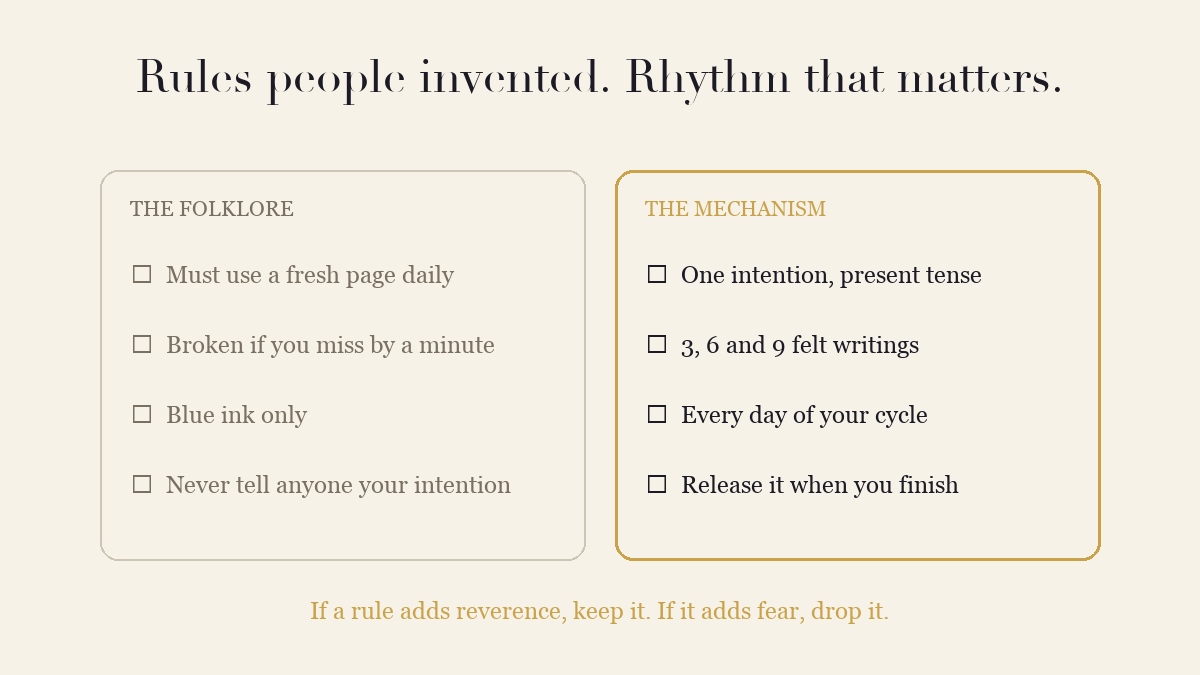
Real rules and invented rules, side by side
| The “rule” | Verdict |
|---|---|
| Present tense, one intention | Real. The load-bearing one. |
| 3, 6 and 9 felt repetitions | Real. Felt matters more than counted. |
| Every day of the cycle | Real. Repetition across days is the mechanism. |
| Release at the end | Real. Grasping is the opposite signal. |
| Same times every day | Helpful, not required. |
| Handwritten, never typed | Partly true. Handwritten and felt is best. |
| Total secrecy | Sensible instinct, not a condition. |
| Miss a day, restart the cycle | Invented, and actively harmful. |
| Blue ink, fresh page | Ceremony. Keep it if it adds reverence. |
| Start on a new moon | Ceremony. Nothing in the method requires it. |
| Never change the wording mid-cycle | Mostly true, for a practical reason. |
| Exactly 33 days or it does not count | Invented. Cycle length is yours. |
The rules that actually matter
Strip everything away and the method has four working parts.
1. One intention, in the present tense
Written as if already true: “I am”, “I have”, never “I want”. Wanting affirms the lack. This is the single most load-bearing rule, covered in depth in how to write a 369 affirmation.
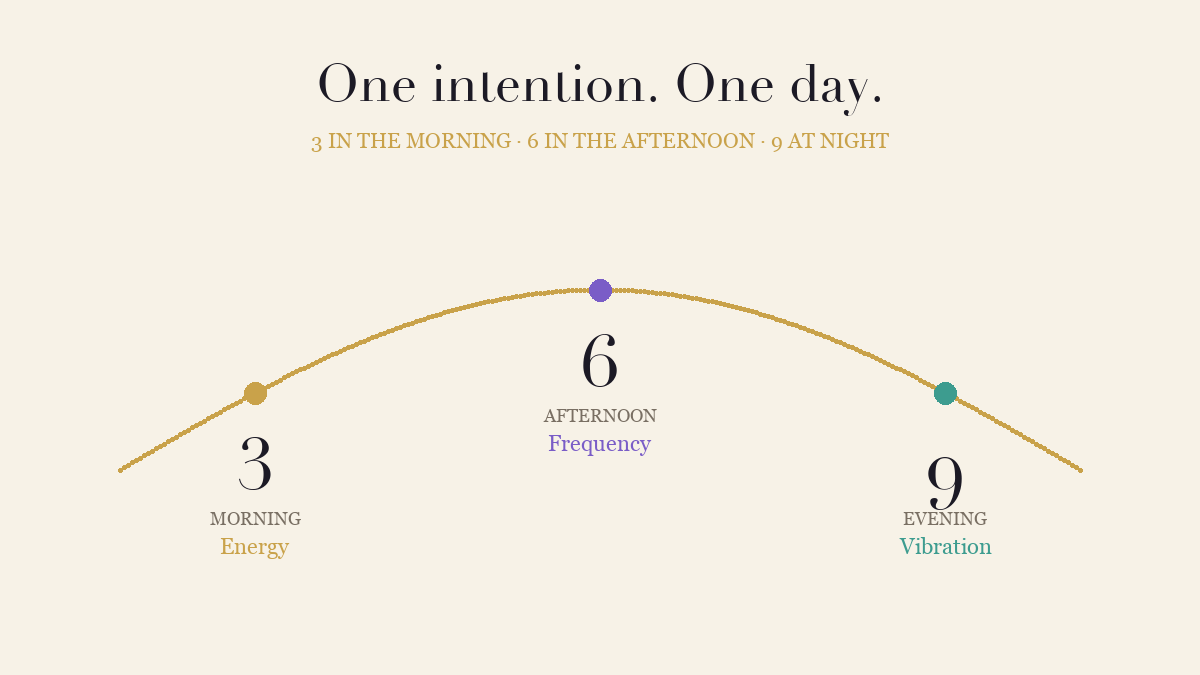
2. Three, six and nine felt repetitions
The counts give the day its shape: a light start, a stronger return, a deep finish. Felt matters more than counted. Nine hollow lines move nothing; three felt ones move you.
3. Every day of your cycle
Repetition across days is where the change happens. A well-known University College London study found that new habits took an average of 66 days to become automatic, with a wide range either side, which is a useful reality check on any promise of overnight transformation. You can read the research summary at UCL’s own report on habit formation. The method’s longer cycles exist for exactly this reason.
4. Release at the end
Finish each session by letting the intention go rather than gripping it. Grasping is the opposite signal to trust.
The folklore, examined honestly
“You must write at exactly the same time each day”
Helpful, not required. Anchoring the writings to consistent times builds the habit faster, but the method survives a late afternoon session. What breaks it is skipping the writing entirely, not writing it at 4pm instead of 1pm.
“Miss a day and you must start the whole cycle again”
This one causes real harm, because it converts a single ordinary slip into a reason to quit. A missed day resets your streak count; it does not erase the eighteen days of rehearsal that came before it. Begin again the next morning. The practice is the point, not the perfection.
“It must be handwritten, never typed”
Partly true. Handwriting is slower, and the slowness is where the feeling gets in. If handwriting is genuinely impossible for you, typed and felt beats handwritten and hollow. But if you can write by hand, do.
“Keep your intention secret or it will not work”
There is a sensible instinct buried in here: announcing goals invites opinions, and opinions invite doubt. But secrecy is protection for your state, not a magic condition. Tell a supportive person if it helps you; tell nobody if it keeps the signal clean.
“Blue ink, fresh page, new moon start”
Pure ceremony. And here is the honest thing about ceremony: it is not worthless. A special pen, a clean page, a moon-phase start date can add reverence, and reverence deepens feeling. The test is simple. If a rule adds reverence, keep it. If it adds fear, drop it.
“It has to be 33 days, or 45, or whatever number I read”
Cycle length is a choice, not a law. Twenty-one days is the common starting
arc because it is long enough to move past novelty and short enough to finish.
Twenty-eight and 33 day cycles suit people who want the habit to settle
properly. None of these numbers is load-bearing; finishing is.
“You must never change a single word once you start”
Mostly worth keeping, for an unglamorous reason. A sentence needs repetition
to stop sounding like a costume, and rewriting it every few days means starting
week one over and over. That said, if you discover on day three that your
sentence is phrased from lack, fix it. A better sentence beats a consistent bad
one.
“Do not do it during Mercury retrograde”
Nothing in the 369 method depends on planetary positions. If astrology is
part of your practice, let it be part of your practice; just do not let a
calendar talk you out of eighteen lines.
“You have to visualise while you write”
Not required, and for some people actively distracting. What is required is
that the sentence lands as something other than dictation. If imagery helps you
get there, use it. If a slow breath and a plain reading get you there faster,
use that instead. Living in the end is the
deeper version of this idea if you want to pursue it.
One rule we do add
Arrive before you write. A minute of slow breathing, with the exhale longer than the inhale, shifts the nervous system towards its rest state, which is the state the practice works best in. Harvard Health’s guide to breath control explains the physiology plainly. It is why 369 Rituals opens every session with a 6·3·9 breath ceremony rather than dropping you straight onto a blank page.
Everything else is yours to choose. The method is a rhythm, not a rulebook.
Quick answers
What are the actual rules of the 369 method? Four: one
present-tense intention, three then six then nine felt repetitions, every day of
your cycle, and release at the end. Everything else you have read is optional.
What happens if I miss a day of the 369 method? Nothing
breaks. Write again the next morning. A missed day resets a streak count, it
does not erase the rehearsal you have already done, and restarting from day one
is the fastest way to talk yourself out of the practice altogether.
Does the 369 method have to be handwritten? Handwriting is
slower and the slowness helps the words land, so prefer it where you can. A
phone you always carry beats a notebook you leave at home. Typed and felt beats
handwritten and hollow.
Do I have to write at exactly the same time every day? No.
Consistent times build the habit faster, which is the only reason the advice
exists. A late afternoon session is still an afternoon session.
Do I have to keep my intention secret? No. The useful
instinct underneath the rule is that announcing goals invites opinions and
opinions invite doubt. Tell a supportive person if it steadies you, tell nobody
if that keeps things cleaner.
Does the ink colour or paper matter? Not mechanically. It can
matter to you, and that is a real effect. If a particular pen makes the session
feel like a ritual rather than a chore, that reverence deepens the feeling, which
is the part that works.
Can I change my intention partway through a cycle? Finish
the cycle if you can. If the sentence is phrased from lack rather than wholeness,
fix it now rather than practising the wrong thing for three weeks.
Sources and further reading
- How long does it take to form a habit? (University College London): the 66-day median, and why a missed day does not undo a cycle
- Breath control helps quell the stress response (Harvard Health): the physiology behind arriving before you write