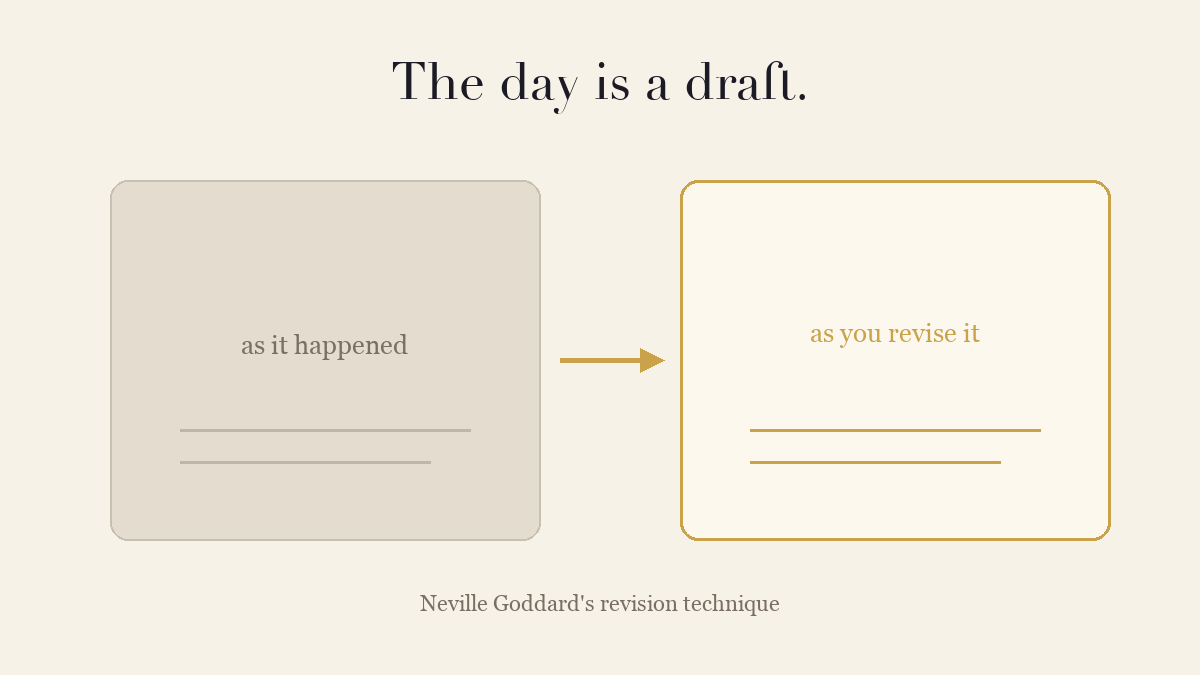
Of all the techniques taught by Neville Goddard, revision is the one that sounds most audacious and turns out to be the most practical. The instruction: at the end of each day, take the scenes that went wrong and rewrite them in imagination as you wish they had gone. Replay the revised version until it feels like the memory.
Neville’s own claim was metaphysical: revising the past changes its momentum, so tomorrow grows from the day you revised rather than the day you resented. You do not need to go that far with him for the practice to earn its place. Read psychologically, revision is a nightly discipline for closing the day without residue, and residue is what most of us carry to bed.
How to practise revision, step by step
1. Review the day briefly
In bed, or just before, run back through the day and notice the moments that snagged: the sharp reply, the meeting that went sideways, the thing you wished you had said. Do not wallow; you are locating scenes, not reliving them.
2. Choose one scene
One is enough. Revision is a scalpel, not a floodlight. Pick the moment that is still generating heat.
3. Rewrite it as you wish it had gone
Replay the scene in imagination, but revised. The conversation goes warmly. The email lands well. You respond with the patience you actually have on your best days. Make it specific and make it sensory: what is said, in what tone, how it feels in your chest.
4. Replay until it feels settled
Loop the revised scene gently a few times, the way you would smooth a crease. Neville taught that the ideal moment for this is the drowsy threshold before sleep, the state sleep researchers call hypnagogia, when the mind is unusually image-rich and receptive. The Sleep Foundation’s overview of hypnagogia is a good plain-language read on that state. Falling asleep inside the revised scene is not a failure of the practice; it is the practice completing itself.
What revision is not
It is not denial. You are not pretending the difficult conversation never happened, and revision is no substitute for an apology owed in the real world. What it changes is the state you carry forward. An unrevised sting replays itself for days and colours how you meet the next similar moment. A revised one closes.
It is also not only for bad days. Revising a neutral day upward, replaying it with a little more gratitude than you felt at the time, is quietly powerful, and lines up with what research on gratitude keeps finding: regularly attending to what went right measurably lifts wellbeing, as summarised by Harvard Health’s review of gratitude research.
Where it fits in a 369 practice
Revision slots naturally into the evening. The method’s nine writings close the day’s practice; revision closes the day itself. Write your nine, then, as the lights go out, revise the one scene that needs it and let the drowsiness carry the corrected version down. Done nightly, the two practices reinforce each other: the writings rehearse who you are becoming, and revision stops the old self’s worst moments from voting on tomorrow.
It pairs especially well with living in the end, and the wider toolkit is mapped in our complete guide to Neville Goddard’s techniques. Start tonight: one scene, rewritten, held gently until sleep takes it.
A worked example
Abstract instructions are easy to nod at and hard to use, so here is one
revision in full.
What happened. A meeting where you were asked a question you
knew the answer to, and you fumbled it. You spent the afternoon replaying the
fumble and drafting the answer you should have given.
The scene to revise. Not the whole meeting. Just the ten
seconds between the question and your reply.
The revision. Lying in bed, drowsy, you replay those ten
seconds: the question arrives, there is a small pause, and you answer clearly.
You feel the steadiness in your chest rather than picturing the room in detail.
Someone nods. That is the whole scene.
The repetition. You run it perhaps five or six times, more
slowly each pass, until the version stops carrying charge and starts feeling
ordinary. Then you sleep.
The point is not that the meeting changed. It is that the version your
nervous system rehearses overnight is now the steady one, and you are marginally
less braced the next time a question lands.
Revision and rumination are not the same thing
This is the distinction worth guarding, because the two look almost identical
from the outside and pull in opposite directions.
| Rumination | Revision |
|---|---|
| Replays what happened | Replays the corrected version |
| Open-ended, can run for hours | Bounded, a few minutes and done |
| Rehearses the feeling of the failure | Rehearses the feeling of it going well |
| Leaves you more braced | Leaves you settled enough to sleep |
If a session is making you tenser rather than calmer, you have drifted from
one into the other. Stop, breathe out slowly, and either restart with a smaller
scene or leave it for the night.
Revision sits inside a larger toolkit. The full guide to Neville’s techniques covers where it fits, SATS is its natural companion at the same hour, and the 369 method supplies the daily structure that keeps either of them from becoming occasional.
Quick answers
What is Neville Goddard’s revision technique? A bedtime practice: pick one scene from the day that went badly, and replay it in imagination as you wish it had gone, until the rewritten version feels settled. Neville taught it as a way of refusing to let the day stand as recorded.
Does revision change what actually happened? No, and treating it as time travel is how people end up disappointed. What it changes is the version you rehearse and carry forward, which affects how you meet the same situation next time.
When should I practise revision? Last thing, in the drowsy state before sleep, for the same reason SATS uses that window. A tired mind accepts a scene with less argument than an alert one.
How long should revision take? A few minutes. One scene, replayed until the tension goes out of it. Long sessions tend to turn into rumination, which is the opposite of the intent.
What if I cannot let the real version go? That is usually a sign the scene is too big. Choose a smaller moment inside it, a single exchange rather than the whole confrontation, and revise that.
How does revision fit with the 369 method? It sits naturally after the evening nine. The writing sets the direction, revision clears the day’s debris so it does not argue with tomorrow.