Breath of Fire is the most energising practice in the yogic canon: rapid, rhythmic breathing driven entirely by the belly, done in short rounds, finished with a long still hold. Kundalini yoga uses it to awaken energy. Older Hatha texts call it Kapalabhati, Sanskrit for skull (kapala) and shining (bhati), the “skull-shining breath”, often spelled kapalbhati, and class it as both a cleansing practice and a form of pranayama, the yogic discipline of guiding prana, the breath’s life-force. It is also the newest ceremony in 369 Rituals, where your phone itself keeps the rhythm through haptic pulses.
This guide explains exactly how kapalabhati pranayama works, what a “pump” actually is, what the research honestly says about the benefits, and how to fold fire breath into a 3·6·9 manifestation practice.
What Breath of Fire actually is
Strip away the mystique and the technique is one repeated movement:
- One sharp exhale through the nose. You snap the navel back toward the spine, a quick, strong squeeze of the belly, like blowing out a candle through your nostrils.
- A passive inhale. You do nothing. The belly releases, and air falls back in on its own.
That pair (one forceful exhalation, one passive inhalation) is one pump. The abdominal muscles and diaphragm do all of it; the entire skill of Breath of Fire is learning that the exhale is the work and the inhale is the rest. Beginners almost always try to do both, which is exhausting and self-defeating. Rest a hand on your belly for your first rounds: it should be the only thing moving. Shoulders still, face soft, mouth closed throughout.
Rounds, and the hold where the fire settles
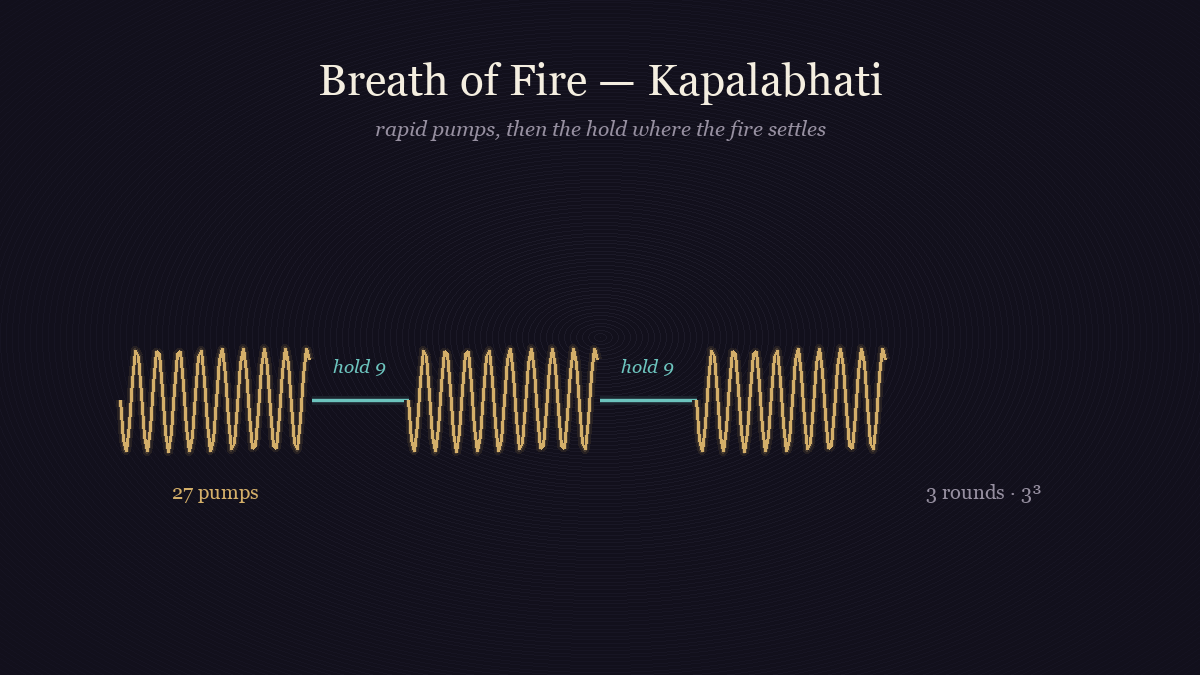
Unlike slow yogic breathing techniques, the long ocean-sound ujjayi, or our own 6·3·9 exhale, fire breath is practised in rounds, not marathons. Teachers traditionally tell beginners to start with about 30 seconds of pumping; In 369 Rituals a round is 27, 54 or 81 pumps, 3³, 2×3³ and 3⁴, because even the arithmetic keeps the trinity, at a brisk but followable ninety pumps a minute. The 27-pump round runs about eighteen seconds, right in line with that traditional starting dose, and a session is three rounds.
Between rounds comes the part the practice is actually famous for: you breathe all the way in and hold, lungs comfortably full, for a nine-count. This is the stillness after the storm. The warmth, the tingling, the bright and very quiet head that practitioners describe, almost all of it is met here, in the hold, not during the pumping. If you take one thing from this guide: do not skip the holds. They are not rests between the exercise. They are the exercise.
What the research honestly says
We hold ourselves to a rule in this app: tradition is attributed to tradition, and science is only cited where it exists. So, honestly:
On rapid yogic breathing specifically, the studies are small but consistent in direction. Trials of Kapalabhati and similar high-frequency yoga breathing report short-term increases in alertness and measurable changes in attention-task performance immediately after practice. A frequently cited line of EEG work found increased beta activity (the brain’s alert-and-engaged signature) following fast pranayama. These are small samples and short horizons; nobody serious claims fire breath cures anything.
On breathing practice in general, the evidence is stronger. A 2018 systematic review in Frontiers in Human Neuroscience (Zaccaro and colleagues) looked at how slow, deliberate breathing techniques affect the nervous system and found consistent links to increased heart-rate variability and reduced markers of stress arousal. That review concerns slow breathing (the Settle and Centre end of our practice) but it establishes the larger honest point: how you breathe measurably changes your state.
The benefits of breath of fire, honestly stated
What the tradition claims, Hatha yoga counts kapalabhati among the shatkarmas, its six cleansing practices: the forceful exhalations are said to clear the respiratory passages and sinuses, stoke the digestive fire, and kindle heat at the solar plexus. We pass those claims on as tradition, not physiology, but anyone who has finished three rounds knows why the cleansing story stuck.
What practitioners report, heat in the body, a tingling scalp or hands, and a head that feels rinsed clear. The tradition calls the heat tapas, inner fire, and treats the practice as fuel for transformation. Our framing: the feeling is real, the mechanism is vigorous diaphragmatic exercise plus a respiratory pattern your body reads as “awake now”, and the meaning you give it is yours.
Who should not do it
Fire breath is vigorous, and honesty about that is part of respecting it. Skip it if you are pregnant, have high blood pressure or heart trouble, or are prone to feeling dizzy or lightheaded, and whoever you are, stop the moment anything feels wrong. Ending a round early is not failure; it is good form. The gentler doors, the 6·3·9 Settle breath, the triangle Centre breath, are always open, and they are the better daily companions anyway. Fire is for ignition, not for always.
Fire breath inside a 369 practice
The 3·6·9 method is a rhythm method: intention repeated at the day’s thresholds. Fire breath slots into that rhythm as the activator:
- Before the morning Energy writing. Three rounds of 27, then straight into writing your intention three times with a lit-up nervous system. The contrast with writing half-asleep is immediate.
- Before work that matters, or before meditation. A pitch, a difficult conversation, a creative block: two minutes of fire where you might have reached for a third coffee. Yogis have long paired it with sitting practice: fire first, stillness after, and the stillness goes deeper.
- Never before sleep. This is the one breath in the app that points upward. Evenings belong to the 6·3·9 exhale, and to living in the end.
How the app teaches it
In 369 Rituals, Breath of Fire lives in the Meditate tab behind the Breathe door. Before your first session the app walks you through the full training (the pump, the rhythm, the hold, the form, the safety) and every session after that is guided by touch: your phone taps each pump at ninety a minute, pulses deeper when a round ends, and rings a bell to release you from each hold. Eyes closed, hands free, no counting. The session ends the way everything in the app ends: with your own intention on screen. You didn’t just breathe; you breathed with something.
Fire breath is part of 369 Rituals Premium, alongside the triangle Centre breath, Solfeggio frequencies, and the full depth of the practice. The Settle breath, the app’s 6·3·9 signature, is free, always.
Quick answers
What is Kapalabhati breath of fire? A pranayama technique built on short sharp exhales through the nose driven by the abdomen, with the inhale left passive. The name translates roughly as “skull shining”. It is practised in rounds rather than continuously.
How many rounds of Kapalabhati should a beginner do? Start with one or two rounds of about 27 breaths, with a comfortable pause between rounds. Build slowly. The technique rewards control far more than volume, and speed without control is just hyperventilating.
What are the benefits of breath of fire? Practitioners consistently report alertness and mental clarity, and small studies on fast pranayama point to short-term effects on attention and cortical activity. The honest framing is small samples and short horizons. It is not a treatment for anything.
Is Kapalabhati safe? For most healthy people, practised gently, yes. It should be avoided if you are pregnant, have uncontrolled high blood pressure, heart conditions, epilepsy, glaucoma, a hernia, or recent abdominal surgery, and during menstruation many traditions advise skipping it. If you feel dizzy, stop and breathe normally.
Why do I feel dizzy during breath of fire? Usually because the pace is too fast or the exhales are too forceful for your current capacity. Slow down, make the exhales smaller, and take more rest between rounds. Dizziness is a signal to stop, not to push.
When is the best time to practise Kapalabhati? Morning, on an empty stomach, and not close to bedtime. It is a rousing practice, which makes it a poor choice for winding down.
How does breath of fire fit with the 369 method? It suits the morning writing, where the point is to arrive awake and clear. The evening session wants the opposite, so use a long slow exhale there instead.