Solfeggio frequencies are a set of nine tones, from 174 Hz to 963 Hz, that modern sound-healing traditions assign specific qualities: liberation, transformation, intuition, connection. Search for manifestation music and you will drown in videos labelled 432 Hz, 528 Hz, 963 Hz, each promising a different miracle. The claims run far ahead of the evidence, and most articles either swallow them whole or dismiss the whole subject. This guide does neither. Here is what the Solfeggio frequencies are, what is honestly known, and how to use them in a daily practice.
The origins of Solfeggio frequencies, and the “ancient scale” myth
The name borrows from solfège, the do-re-mi system medieval monks used to teach Gregorian chant, usually credited to the eleventh-century monk and music theorist Guido of Arezzo, who took the syllables from a hymn to John the Baptist, “Ut queant laxis”, where each line begins one note higher. That much is genuine music theory, a thousand years old. The modern set of “Solfeggio frequencies”, though, is much younger: it was assembled between the 1970s and the 1990s, when the naturopath Joseph Puleo described deriving six numbers from a numerological reading of the Book of Numbers, and the set later grew to nine and spread through the sound-healing world as “the ancient Solfeggio scale”. Each tone was assigned a quality: liberation, transformation, connection.
So: the syllables are ancient, the hertz values are not. The “ancient Solfeggio scale” as marketed, nine specific sound frequencies the old world supposedly tuned to, is a modern tradition drawing on an older musical vocabulary, not a recovered science. We think being clear-eyed about that from the start makes the practice stronger, not weaker. Traditions do not need false birth certificates to be worth keeping.
The 9 Solfeggio frequencies: the complete list, explained
The full modern set runs to nine tones. Here is the list with the quality each is traditionally assigned, traditionally being the operative word:
- 174 Hz, ease, and a sense of security in the body
- 285 Hz, restoration; the tradition links it to tissue and renewal
- 396 Hz, liberation from guilt and fear
- 417 Hz, clearing what blocks change
- 528 Hz, the famous “love frequency”, also sold as the “miracle tone”: transformation and repair
- 639 Hz, connection and relationships
- 741 Hz, expression and problem-solving
- 852 Hz, intuition; returning to spiritual order
- 963 Hz, awakening and connection; the tradition ties it to the pineal gland and awakening intuition
Many charts also map the nine tones onto the seven chakras, one more modern layering on top of the numbers. No study has verified any of these specific pairings, and you will find the meanings drift from one chart to the next, a tell that this is living folklore rather than fixed physics. What the list is genuinely useful for is choosing a register: the low tones settle, the middle tones accompany work, the high tones brighten. That much you can hear for yourself.
Is 432 Hz a Solfeggio frequency?
Strictly, no, and most articles fudge this. 432 Hz comes from a different tradition entirely: the alternative concert-pitch movement, which argues instruments should be tuned with A at 432 Hz instead of the modern standard 440 Hz (it is sometimes called Verdi’s pitch). It ended up on every “healing frequencies” playlist because it shares the same intuition, that certain tunings resonate more gently in the body, and because a warmer, slightly lower pitch genuinely does sound softer to many ears.
369 Rituals includes 432 Hz alongside the true Solfeggio tones for that honest reason: as a grounding register people find calming, not because of a label. If a chart tells you 432 Hz is an ancient Solfeggio tone, the chart is wrong on both counts, and now you know why.
What the evidence honestly says
The specific mystical claims, that one frequency repairs DNA or another awakens a dormant sense, have no scientific support. What does have support is broader and, for a practitioner, more useful:
Music and steady tones measurably affect the autonomic nervous system, and this is the ground music therapy stands on. Slow, low-stimulus sound lowers arousal, research on sound and vibration consistently links calm listening with reduced anxiety in clinical settings, a picture Johns Hopkins Medicine summarises well.
On 432 Hz specifically, a small randomised pilot study found listening associated with a modest drop in heart rate compared with standard 440 Hz tuning; the study is indexed on PubMed here. One small study proves little on its own, but it points the sensible direction: the value of these tones is physiological settling, not magic. The same honesty applies to “brainwave entrainment” claims, where the marketing runs far ahead of the measurable.
So the honest position is this: the tones will not repair your DNA, and they genuinely can help you settle, focus and stay with a practice. That second thing is not a consolation prize. Settling is the entire doorway to a felt writing session.
Solfeggio frequencies for healing: what that can honestly mean
“Healing frequencies” is the phrase most people arrive through, so let us be precise about what it can and cannot carry. If healing means curing illness, no, nothing here treats anything, and anyone selling a frequency as medicine is selling. If healing means what most practitioners actually experience (a nervous system talked down from the day, sleep that comes easier, a practice you keep because it feels like a refuge) then steady, low-stimulus tone is one of the oldest tools humans have for exactly that, from chant to lullaby. Those are the real benefits of Solfeggio frequencies: settling, easier focus, and for many people better sleep quality, feelings of peace you can actually test tonight, no cosmology required. Use the word in its honest sense and the practice delivers; use it in the miraculous sense and only disappointment does.
The three tones in 369 Rituals
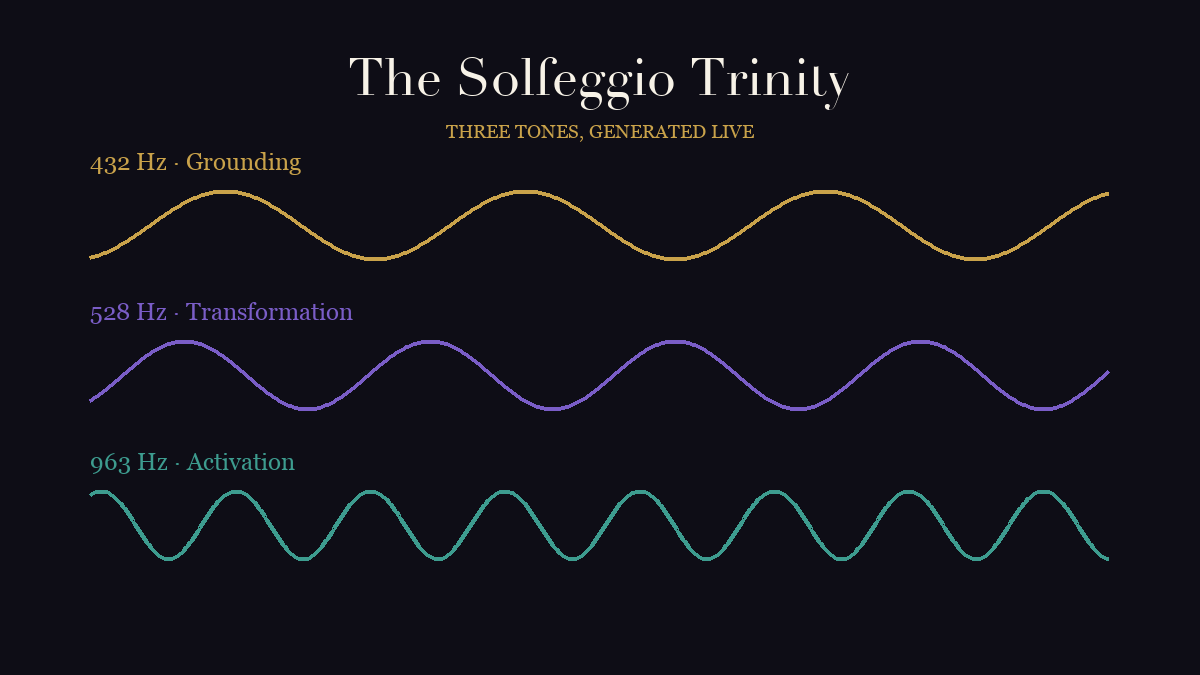
The app generates three Solfeggio tones live on your device, one for each phase of the day. Generated, not streamed: there is no audio file, no network, nothing leaving your phone.
432 Hz, Grounding. A slightly warmer tuning than modern concert pitch, traditionally associated with calm and naturalness. It plays beneath the morning Energy ritual, where the day’s tone is set.
528 Hz, Transformation. The most famous of the set, often called the love frequency in the tradition, associated with repair and renewal. It plays beneath the afternoon Frequency ritual, the session where doubt tends to arrive.
963 Hz, Activation. The highest of the three, traditionally linked to awareness and connection. It plays beneath the evening Vibration ritual and the deeper meditation sessions, where the day is released.
How to use Solfeggio frequencies: sleep, meditation and daily practice
For sleep, choose the low registers (174 or 396 Hz in the tradition) at a volume you can barely notice, and let a timer end it rather than letting it run all night. For meditation and breathwork, one steady tone under the session gives the mind a rope to hold; in the app the 963 Hz tone accompanies the deeper sits, and a tone can sit beneath the breath ceremonies too. For the writing ritual itself, the tone is the room, not the performance, which brings us to the practical rules:
Use headphones; phone speakers reproduce low tones poorly. Keep the volume low, a presence rather than a performance. Let the tone be the room you write in, not the thing you listen to. And treat it as optional, always: some of the deepest sessions happen in silence, and silence is a frequency too.
The tones sit alongside the breath ceremony and the writing itself as part of one arc: arrive, write, release. If the method is new to you, begin with the complete guide to the 369 method; if the stillness side calls you, the meditation timer and its streak are covered across the app, with the full Solfeggio trinity available in Premium.
Belief is not required. Put the tone on, breathe out longer than you breathe in, and write your three lines. The settling does the rest.
If you are using the tones to support a writing practice rather than as listening on their own, two pages are worth pairing with this one: the morning ritual, where a lower tone suits the first three lines, and SATS, where a tone set to fade can carry you to the edge of sleep.
Quick answers
What are the 9 Solfeggio frequencies? 174, 285, 396, 417, 528, 639, 741, 852 and 963 Hz. The first two are later additions to the better known six. Each is assigned a quality by modern sound-healing tradition, from pain relief and release of fear through transformation and connection.
Are Solfeggio frequencies actually ancient? No, and this is the most repeated myth about them. The names borrow from the medieval solfège syllables Guido of Arezzo used to teach chant, which is genuine music history. The specific set of frequencies was assembled in the twentieth century. Old naming, modern numbers.
What is 528 Hz used for? It is the most popular of the set, commonly labelled the love or transformation frequency and sometimes marketed as the “DNA repair” tone. The DNA claim has no support in published science. As a pleasant tone to meditate to, it is perfectly good.
Is 432 Hz a Solfeggio frequency? Strictly no. 432 Hz is an alternative concert tuning for A, not a member of the Solfeggio set, though it is almost always sold alongside them. People who prefer it usually describe it as warmer than standard 440 Hz tuning.
Do Solfeggio frequencies really work for healing? There is no good evidence that any specific frequency has a specific physiological effect. There is reasonable evidence that calm music and slow sustained tones help people relax, and relaxation is genuinely useful. Treat the tones as an aid to attention, not as medicine.
Which Solfeggio frequency should I start with? 528 Hz if you want the popular one, 396 Hz if you want something lower and steadier for winding down, 963 Hz if you like brighter tones for morning practice. Preference matters more here than the assigned meanings.
How long should you listen to Solfeggio frequencies? Ten to twenty minutes is plenty for a session. Keep the volume comfortable. There is no benefit to hours of exposure and no reason to sleep with tones playing all night unless you simply enjoy it.
Can I use Solfeggio frequencies with the 369 method? Yes, and it is a natural pairing. A tone under the writing gives the session an audible beginning and end, which helps the ritual hold its shape.